
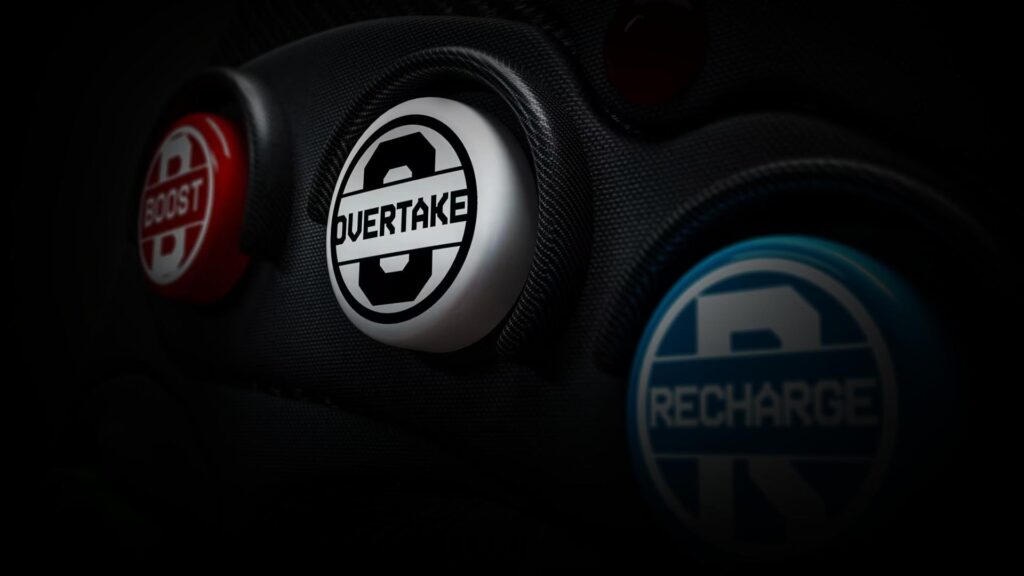
From 2026, Formula 1 will say goodbye to DRS and introduce a new tool designed to favor overtaking: Overtake Mode. It is not just a simple name change, but a conceptual revolution that shifts the focus from aerodynamics to power unit power management. A change that will deeply affect the way drivers attack, defend, and build a maneuver during a race.
What is F1 2026 Overtake Mode?
Even the Formula 1 lexicon is destined to change. Overtake Mode (known until today as Override Mode) is a function that allows the driver, when within one second of the car ahead, to use extra electrical power to attempt an overtake.
It is the direct heir to DRS, but with a substantial difference: it does not act on the rear wing, but rather on the power delivered by the power unit, making overtaking a strategic choice rather than an automatic action linked to a pre-established zone of the track.
Why it replaces DRS
DRS, in its most effective configurations, allowed for speed deltas even exceeding 20 km/h, thanks to the drastic reduction in drag. This was an often decisive advantage, but also heavily criticized for its artificial nature.
With Overtake Mode, the FIA has chosen a different approach: aiding overtaking by intervening on the power factor, leaving the driver with the responsibility of deciding when and how to use the available energy.
The role of ERS-K
The heart of Overtake Mode is the ERS-K, the electrical component of the power unit, consisting of:
– battery
– management control unit
– MGU-K motor-generator
Technical regulations establish that the ERS-K cannot deliver more than 350 kW of power, nor recover more than 8.5 Megajoules per lap.
These 350 kW, equivalent to 476 horsepower, sit alongside the estimated 550+ horsepower of the 1.6-liter turbo V6, which has a fuel flow limited to 100 kg/hour. It is important to emphasize that the two power sources do not add up linearly but work according to complex management logic.
Speed-linked electric boost
When the driver activates Overtake Mode, they benefit from a higher electrical delivery compared to the standard profile, but it is not unlimited. The maximum available power decreases as speed increases, as provided by article C5.2.8 of the technical regulations.
In particular:
– below 340 km/h, the maximum electrical power follows the formula: P (kW) = 1800 − 5 × speed
– between 340 and 345 km/h: P (kW) = 6900 − 20 × speed
– in Override mode (Overtake Mode), below 355 km/h: P (kW) = 7100 − 20 × speed
This system makes energy use more effective at medium-high speeds but requires great precision in management.
When Overtake Mode can be used
According to the sporting regulations, Overtake Mode is always available in timed sessions (free practice, qualifying, and Sprint Qualifying) unless restrictions are imposed by race direction. In the race, however, its use is subject to passing a Detection Line: the driver must be one second or less behind the car ahead to be entitled to activation, much like what happened with DRS.
Once the subsequent Activation Line is passed, the driver can press the boost button and utilize 0.5 Megajoules of additional energy compared to the standard electrical delivery profile. Overtake Mode becomes available from the second lap of the race and can be deactivated by the race director in track conditions deemed dangerous. Its use is also prohibited in the presence of yellow flags or during Safety Car periods.
Overtaking becomes a choice again
Overtake Mode does not guarantee an overtake. Instead, it introduces a new strategic variable, forcing the driver to make a key decision: when to invest energy and when to conserve it. Aggressive use can facilitate an immediate attack but risks exposing the car to a more complex defensive phase in subsequent laps.
From 2026, overtaking in Formula 1 will no longer be linked to a simple “on/off” mechanism, but to a combination of timing, intelligence, and resource management. DRS goes into the archives; in its place comes a system that promises to make track battles more authentic, less predictable, and more tied to the driver’s skill.