
The 2026 Australian GP has already highlighted one of the most discussed technical phenomena of the new Formula 1 era: super clipping. With the next-generation power units, where the electrical component represents about 50% of the total power, energy management has become decisive.
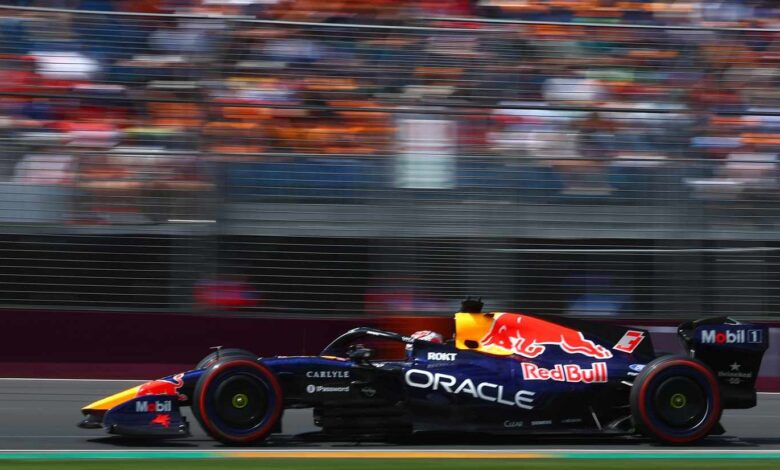
During the Melbourne practice sessions, several teams worked specifically on this aspect, but one of the most evident examples occurred on Max Verstappen’s Red Bull, which experienced the effects of this phenomenon firsthand during Free Practice 2.
What is super clipping and why it happens in F1
Super clipping in F1 is a sudden drop in power that occurs when the power unit’s battery is completely depleted during a straight. At that moment, the MGU-K, the motor-generator connected to the car’s kinetic energy, stops providing assistance to the internal combustion engine and switches to the opposite phase: energy recovery.
When this happens, the excess power produced by the engine is directed toward recharging the battery. The result is that the MGU-K begins to act as a generator.
This process has a direct consequence on performance: part of the internal combustion engine’s energy is used to recharge the battery, thus reducing the overall thrust available for traction. If the combustion engine cannot compensate for the loss of electrical power, the car suffers a noticeable drop in speed.
With the new technical regulations, which have increased the weight of the electrical component to make it equal to the internal combustion engine, these effects are even more pronounced than in the past.
Verstappen loses nearly 50 km/h in Melbourne: the example of super clipping
A concrete example of super clipping was clearly seen during Free Practice 2 of the Australian GP.
In the middle of a fast lap, Max Verstappen suddenly lost a significant amount of speed on the straight leading to the fast chicane of turns 9 and 10 at the Albert Park circuit.
Data indicates that the Dutchman’s Red Bull went from 326 km/h to 279 km/h, with a sudden loss of nearly 50 km/h.
The most significant aspect is that the four-time world champion did not lift his foot off the accelerator. The drop in speed was therefore not caused by a driving error or early braking, but precisely by the depletion of the available electrical charge.
At that moment, the battery was depleted and the MGU-K began the recovery phase, taking power from the internal combustion engine to recharge the accumulator. Without the support of the electrical component, the Red Bull was unable to maintain the same top speed along the straight.
An increasingly important phenomenon in F1 2026
With the next-generation power units, super clipping is set to become an increasingly relevant element in the technical analysis of race weekends, and so we must get used to hearing this new term, just as it was for porpoising during the previous regulatory cycle.
Teams must indeed choose with great precision where to use electrical power and where to recover it, balancing performance and battery consumption. Overly aggressive management can lead to clipping phenomena at the wrong points on the circuit, compromising lap times.
This is precisely why free practice sessions are fundamental: engineers and drivers analyze telemetry data to understand how to best distribute energy along the track.
👇 Ti interessa questo argomento? Clicca sui tag qui sotto per esplorare tutti gli articoli e gli approfondimenti correlati!