
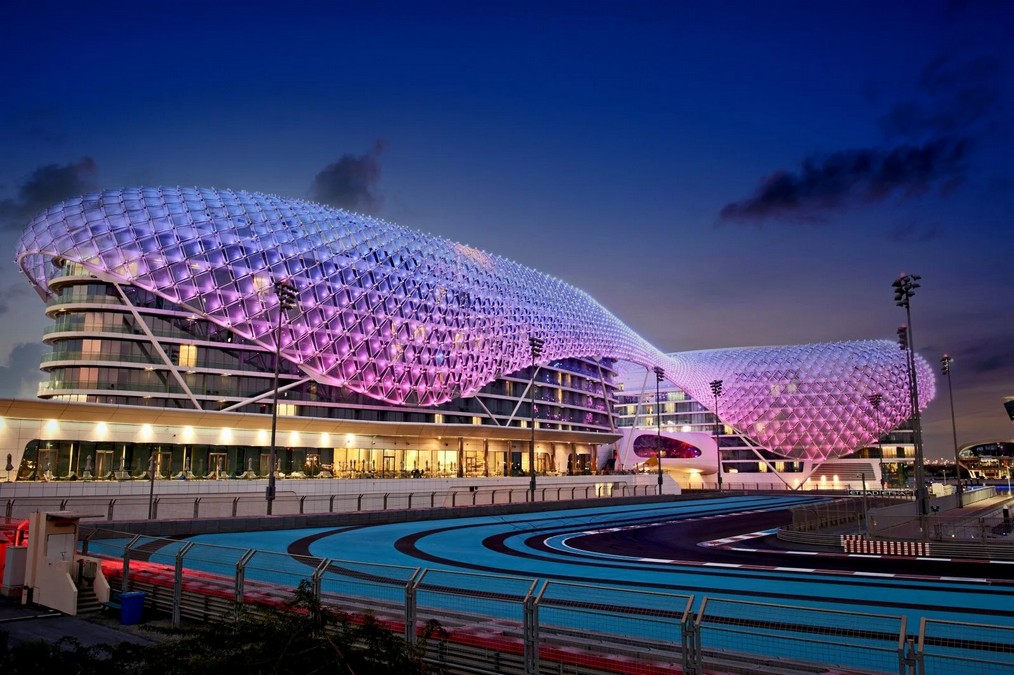
Inaugurated in 2009 and having become an iconic stop on the Formula 1 calendar, the Yas Marina Circuit stands on the artificial island of Yas in Abu Dhabi, representing one of the most ambitious projects ever realized in the United Arab Emirates. The track, immersed in a futuristic setting of illuminated hotels, marinas, and spectacular structures, offers a unique mix of technique, speed, and charm, establishing itself over the years as one of the most anticipated season finales.
Indice dei Contenuti
Track layout: design, asphalt, and conditions
The race is not just a sporting event: Yas Marina is a setting where driver precision meets delicate variables such as sunset, temperature changes, and grip that evolves lap after lap. A context that tests teams and drivers, always ensuring an unforgettable backdrop for fans.
At 5.281 km, the Yas Marina Circuit is one of the most modern and complex tracks in the entire world championship. Designed by architect Hermann Tilke, it is run counter-clockwise and combines long straights, heavy braking zones, and medium-speed corners that reward those who can maintain a clean and consistent line.
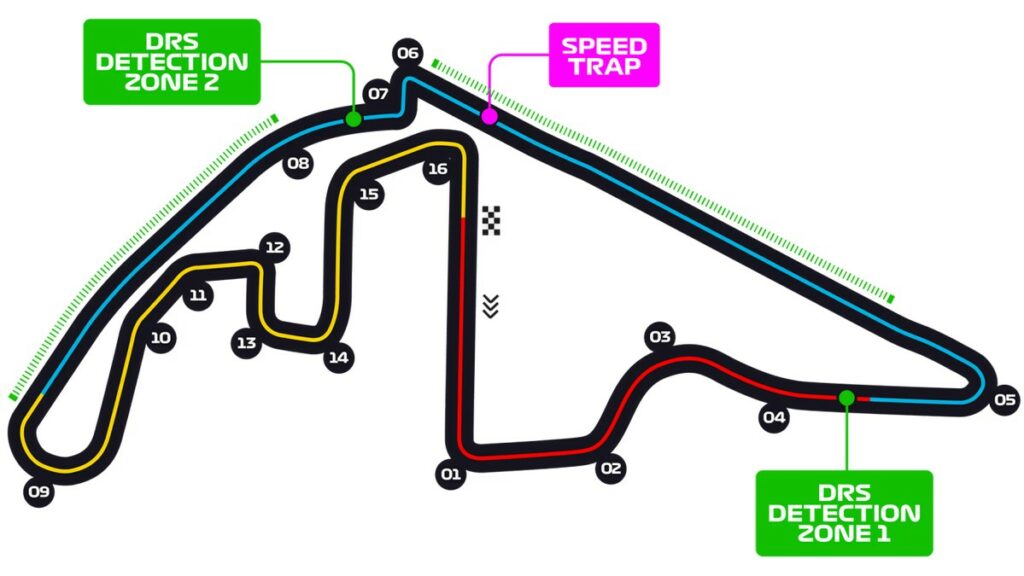
The two main chicanes and the very long straight of over one kilometer allow for peaks close to 330 km/h, making the track an ideal laboratory for testing aerodynamic efficiency and traction. The asphalt, renewed in several areas in 2021, has progressively become smoother, with medium-high tire wear, especially in evening race conditions.
One of the distinctive elements is the day-to-night transition: the track temperature can drop by as much as 10 degrees between the start and end of the race, influencing grip, tire consumption, and strategies. The wind coming from the gulf should not be underestimated either, as it can deposit sand and make certain phases of the weekend unpredictable.
The two DRS zones, on the straight leading to the Turn 5 chicane and on the one following Turn 6, are the main points for attempting an overtake.
Lap analysis: corners and key overtaking points
The lap starts with significant braking into Turn 1, where maintaining stability on entry is fundamental to avoid compromising the exit toward the first sector. From there, you enter a fluid sequence leading to Turn 5, one of the hardest braking points in the world championship and a prime location for overtaking attempts.
The middle section is dominated by the very long straight connecting Turn 5 to Turn 6: here, DRS offers great opportunities, but managing the subsequent braking point is crucial to avoid lock-ups.
The final part of the circuit, redesigned in 2021 to slow the cars down less, is a succession of technical corners requiring millimetric precision. Turns 12 and 13 make up a flowing section, while Turn 16 and the final double left require impeccable traction to launch the car onto the finish line.
Yas Marina Circuit: Complete Technical Data
| CHARACTERISTIC | DESCRIPTION |
|---|---|
| Track length | 5.281 km |
| Race laps | 58 |
| Total distance | 306.1 km |
| Number of corners | 16 |
| DRS Zones | 2 |
| Iconic corner | Turn 5 – most important braking point of the lap |
| Top speed | Over 330 km/h |
| Average pit stop time | Approximately 22–23 seconds |
| First F1 edition | 2009 (Sebastian Vettel victory) |
| Last winner (2024) | Max Verstappen |
| 2024 Pole position | Max Verstappen – 1:22.146 |
| Race lap record | Max Verstappen – 1:26.103 (2023) |
| Typical weather conditions | Warm in the afternoon, cool in the evening (22–30°C) |
Corner-by-Corner Detail
| Corner No. | Name/Position | Characteristic |
|---|---|---|
| 1 | Turn 1 | Sharp braking, important for setting up the first sector. |
| 2–3 | Fast sequence | Requires stability and aerodynamic downforce. |
| 4 | Left kink | Leads into the most iconic braking zone. |
| 5 | Hairpin | Main overtaking point, brutal braking. |
| 6 | Chicane 6–7 | Crucial exit for the following straight. |
| 7–8 | DRS Straight | Maximum speed of the track. |
| 9 | Complex braking | Easily subject to lock-ups. |
| 10–11 | Fluid turn | Requires a clean line. |
| 12 | Flowing corner | Important to maintain high minimum speed. |
| 13 | Change of direction | Zone where the final rhythm is built. |
| 14–15 | Medium-speed corners | Reward a stable rear setup. |
| 16 | Last corner | Decisive for speed onto the finish line. |
Statistics, Records, and Curiosities
- Most successful team: Mercedes
- Recent era dominator: Max Verstappen
- First GP with a sunset race: Abu Dhabi 2009
- Iconic detail: passing under the W Abu Dhabi Hotel, one of the most photographed sections in the world
- Circuit capacity: over 60,000 spectators
History of the Abu Dhabi GP in Formula 1
The Abu Dhabi GP entered the calendar in 2009 as the season-ending event. Over the years, it has hosted historic moments, including the 2010 title battle won by Vettel, Rosberg’s first and last world championship in 2016, and the controversial 2021 finale between Hamilton and Verstappen.
Thanks to its modern structure, the night race, and a spectacular setting, the Abu Dhabi GP has become one of the most anticipated stops, a symbol of the Formula 1 season finale.
Roll of Honor: Last Winners of the Abu Dhabi GP
| SEASON | FINISHING ORDER |
|---|---|
| 2024 | 1 – Lando Norris (McLaren) 2 – Carlos Sainz (Ferrari) 3 – Charles Leclerc (Ferrari) |
| 2023 | 1 – Max Verstappen (Red Bull) 2 – Charles Leclerc (Ferrari) 3 – George Russell (Mercedes) |
| 2022 | 1 – Max Verstappen (Red Bull) 2 – Charles Leclerc (Ferrari) 3 – Sergio Pérez (Red Bull) |
| 2021 | 1 – Max Verstappen (Red Bull) 2 – Lewis Hamilton (Mercedes) 3 – Carlos Sainz (Ferrari) |
Schedule and date of the Abu Dhabi GP
The Abu Dhabi weekend will close the Formula 1 season as always. It starts on Friday, December 5, 2025, with Free Practice 1 and 2 (live on Sky F1 and Now). On Saturday, December 6, FP3 and Qualifying will take place, visible on Sky F1 and delayed on TV8. On Sunday, December 7, 2025, the race will start at sunset, offering a unique spectacle as it does every year.
👇 Ti interessa questo argomento? Clicca sui tag qui sotto per esplorare tutti gli articoli e gli approfondimenti correlati!