F1 Miami 2026: oversized brakes between Brembo history and new engineering challenges
At the 900th GP with renewed Brembo technology and the technical transition to the 2026 single-seaters. New discs with diameters up to 345 mm and 1,440 ventilation holes to manage the braking with the reduced power of the current season.
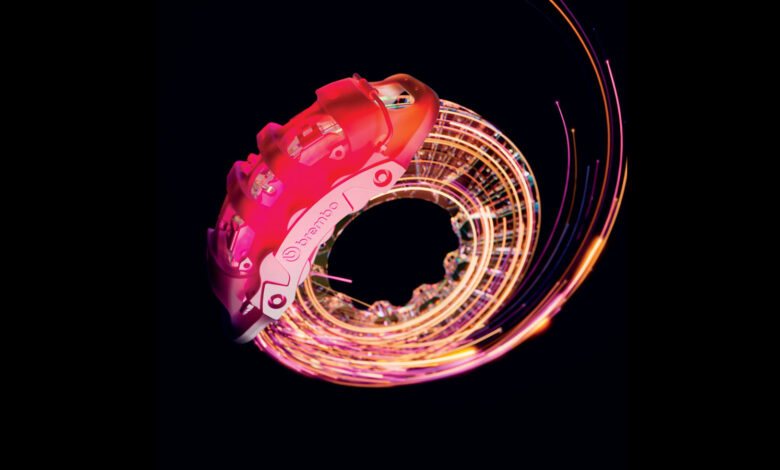
The Formula 1 World Championship restarts in Florida with the Miami GP which marks an important milestone: Brembo’s 900th presence in Formula 1. For the Italian company #1 in the brake sector, it all began in 1975 with the supply of cast iron discs to Ferrari and today with 538 victories achieved, one gets an idea of how much Italian excellence has shone on the track.
Track analysis: little fatigue, much precision
From a purely mechanical point of view, the Miami International Autodrome is not a “brake-eater”. On a severity scale from 1 to 5, Brembo engineers place it at an index of 2. We are talking about a circuit where brakes are applied for less than 10 seconds per lap (about 11% of the total time). Yet, one must not lower their guard: there are three braking points classified as “Hard”.
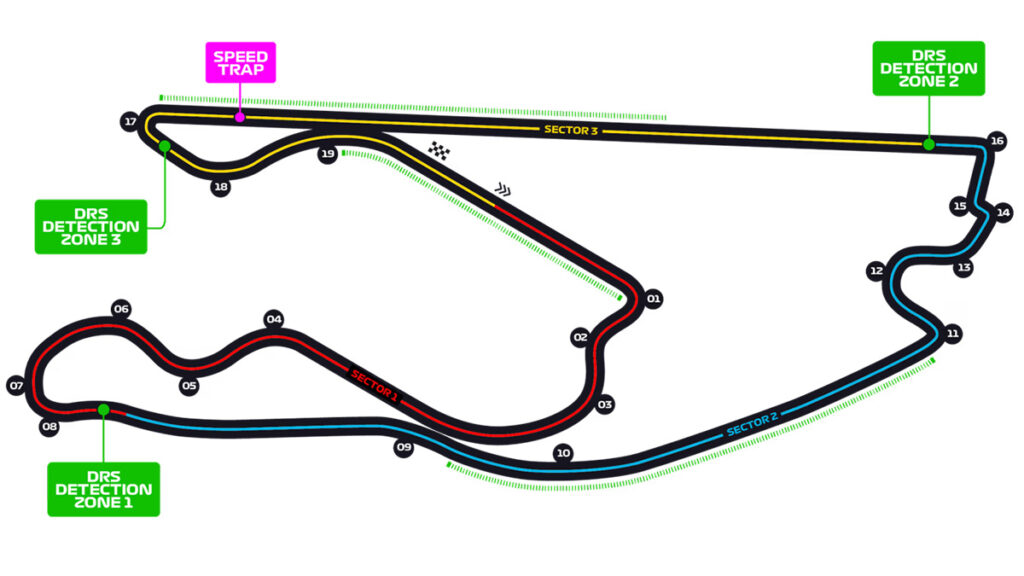
The critical point is Turn 17 where the most demanding braking point is reached after the long straight. It goes from 320 km/h to just 78 km/h in just 3.66 seconds. Here, drivers must exert a pedal load of 114 kg, releasing a braking power of 1,734 kW.
The 2026 evolution: how braking has changed
This 2026 has brought radical technical changes even to the braking systems. Compared to last season, we observe an interesting phenomenon: braking powers have dropped, but stopping distances have lengthened.
Let’s take the first corner: power has dropped from 2,426 kW to 1,660 kW. Why? The load required from the driver has decreased (from 169 kg to 120 kg), but physics is unforgiving: to stop the current single-seaters, more time (from 2.60 to 2.94 seconds) and more distance (+19 meters compared to 2025) are needed. It is a different dynamic that requires drivers to have renewed sensitivity in modulating the pedal.
Renewed technology: the new carbon discs
As an engineer, attention always falls on the components. This year the braking “package” has grown, literally:
- Diameter: we go from 328 mm in 2025 to the current 330-345 mm.
- Ventilation: we have gone from 1,050 holes to 1,440 holes, reducing the diameter of the single hole to 2.5 mm to maximize the heat exchange surface.
- Mass: unit weight has risen to 2 kg (it was 1.75 kg).
This evolution is not a simple increase in size, but an engineering response necessary to manage the new inertia and aerodynamic demands of the 2026 cars.
Brembo 900 GP
Celebrating 900 GPs means honoring the work done for 15 different teams and 44 legendary drivers. Seeing names like Michael Schumacher at the top of the list of winners with Brembo systems (91 successes) reminds us that behind every braking point at the limit there is a millimetric calculation, a customized caliper, and a constant search for perfection. Congratulations to this Italian excellence!
👇 Ti interessa questo argomento? Clicca sui tag qui sotto per esplorare tutti gli articoli e gli approfondimenti correlati!