
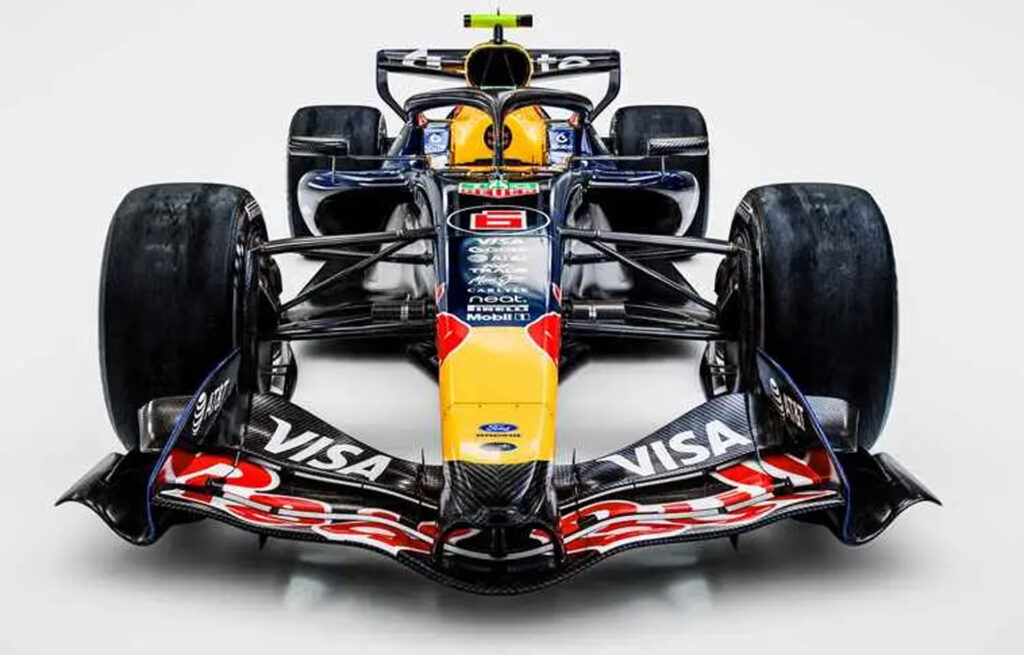
With the presentation of the RB22, Red Bull Racing inaugurates a new era in Formula 1. Between the farewell to Honda, the return of Ford as a technical partner, and a livery that recalls the past, Milton Keynes sends a clear signal: 2026 will be the year of a team ready to write a whole new chapter.
Indice dei Contenuti
Red Bull, the start of a new era
For Red Bull Racing, 2026 is not just the start of a new season: it’s the dawn of a new era. A change that goes far beyond the end of the technical cycle of the ground effect cars introduced in 2022 and definitively archived at the end of 2025. It doesn’t even end with the recent significant departures that have marked the top of the team. The transition is deeper, more structural, almost identity-defining.
Between December 31, 2025, and January 1, 2026, in Milton Keynes, a fundamental chapter in the team’s history closed. Honda is no longer part of the project, having moved to Aston Martin, and now the technical responsibility rests entirely on the shoulders of Red Bull Powertrains, supported by Ford. The time for testing is over: now it’s time to prove.
Detroit, Ford, and the RB22 of change
The choice of Detroit, Michigan, for the presentation was not random. In the heart of the Blue Oval, Red Bull Racing unveiled the 2026 livery through a dummy single-seater, sending a clear message: Ford is back in Formula 1 as a technical and commercial partner of the Milton Keynes team.

The new livery marks a return to the past in graphic details, with Red Bull logos once again outlined in white, while the lighter blue dominates the nose, sides, and engine cover, enriched by geometric elements and the Ford Racing logo prominently displayed. In the background, the RB22 project prepares for its track debut in the tests of Barcelona, accompanied by a line-up that combines certainties and bets: Max Verstappen, a team pillar, and Isack Hadjar, facing the most challenging test of his young career.
Red Bull RB22 technical sheet comparison with the RB21
The comparative table contrasts the Red Bull RB22 (2026 season) with its predecessor, the RB21 (2025 season), to highlight the generational leap due to the new technical regulations.
| Characteristic | Red Bull RB21 (2025) | Red Bull RB22 (2026) |
| Power Unit | Honda RBP001 (V6 Turbo Hybrid) | Red Bull Ford (V6 Turbo Hybrid) |
| Power Ratio | ~80% Thermal / 20% Electric | ~50% Thermal / 50% Electric |
| ERS Power (MGU-K) | 120 kW (160 HP) | 350 kW (470 HP) |
| MGU-H | Present | Absent (Red from the regulations) |
| Fuel | E10 (10% ethanol) | 100% Sustainable / Drop-in |
| Minimum Weight | 798 kg | 768 kg (-30 kg) |
| Wheelbase (Length) | 3,600 mm | 3,400 mm (-200 mm) |
| Car Width | 2,000 mm | 1,900 mm (-100 mm) |
| Aerodynamics | Standard DRS (rear wing) | Active Aero (Z-Mode and X-Mode) |
| Tires (Width) | 305mm (Front) / 405mm (Rear) | 280mm (Front) / 375mm (Rear) |
The difference between the RB21 (2025) and the RB22 (2026) is not just a simple update, but a true technical revolution. If the RB21 is the evolutionary pinnacle of the “Ground Effect Cars” born in 2022, the RB22 inaugurates the era of “Nimble Cars”.
Drivers will need to be careful with the brake temperatures on the RB22. Since the MGU-K recovers much more energy by slowing the car, traditional brake discs will be used less and risk cooling down too much, making braking unpredictable.
Aerodynamic Philosophy: from DRS to Active Aero
This is the most visible novelty. On the RB21, the driver can only open the rear wing flap (DRS) when less than a second behind the car ahead. On the RB22, the entire aerodynamics is “alive”:
- Z-Mode (Cornering): the front and rear wings open to offer maximum downforce in corners. The RB22 will have about 30% less downforce compared to the RB21, making driving more physical and the car more slippery.
- X-Mode (Straight): on straights, the flaps of both wings close to reduce drag by 50%. This system is available to all drivers, not just those attacking.
The Heart: from Honda to Red Bull-Ford
The engine transition is the most risky and ambitious change for the team:
- RB21 (Honda): a dominant internal combustion engine supported by a “light” electric part (160 HP). Energy is abundant and constant throughout the lap.
- RB22 (Ford): electric power triples (470 HP). The thermal engine is smaller and less powerful. The challenge will be energy management: if the driver drains the battery too early, the car will “clip” halfway down the straight, losing hundreds of meters to competitors.
Dimensions and Weight: farewell to the “ships”
Cars from the previous era (like the RB21) were often criticized for being too large and heavy, almost clumsy on street circuits like Monaco.
- Agility: the RB22 is 30 kg lighter, 10 cm narrower, and 20 cm shorter.
- Ground Effect: while the RB21 generates almost all its downforce from the floor (venturi), the RB22 returns to a flatter and less sensitive floor. This should definitively eliminate porpoising (bouncing) and make the car less dependent on a very stiff setup.
In summary: what will we see on the track?
The RB21 is a binary car, glued to the ground, focusing entirely on floor efficiency. The RB22 will be a much more nervous car, faster on straights but slower in corners, where the driver’s skill in managing energy recovery during braking and active aerodynamics will make the real difference.